

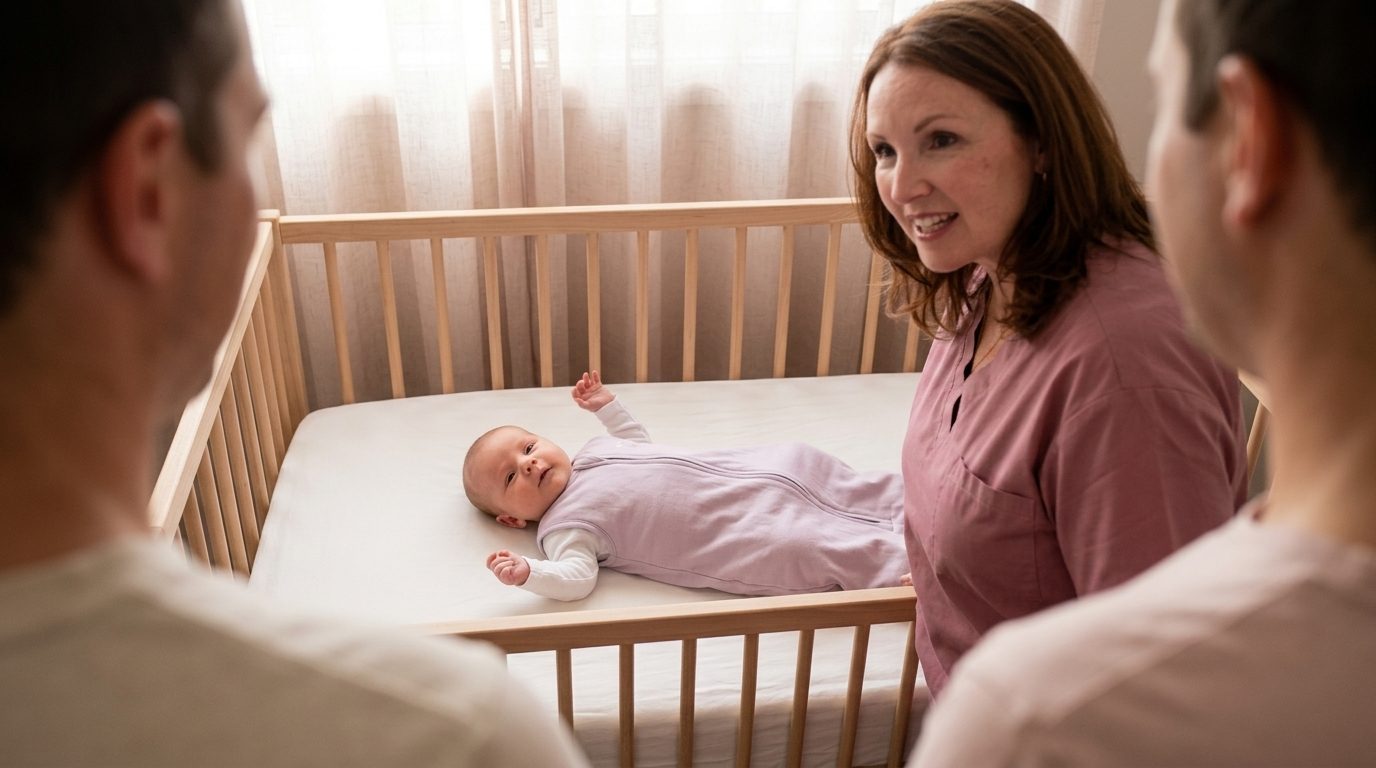
Safe sleep for babies is one of the few corners of newborn care where the advice is national, specific and settled. In Australia it comes from Red Nose, the national authority on safe sleep and sudden infant death, whose six safe sleep recommendations sit behind what you are told in hospital, at your child health appointments and by a midwife visiting you at home. What follows is a plain summary of what those recommendations say, why each one exists, and where to take the questions a list on a website will never answer.
Key Takeaways
- Red Nose publishes six safe sleep recommendations, and they are the national reference point in Australia.
- Back sleeping, for every sleep, is the one that carries the most weight.
- A safe sleep space is a firm, flat mattress with light bedding and nothing soft in it.
- Red Nose recommends baby sleeps in their own space, in your room, for at least the first six months.
- The guidance is easy to read and hard to keep to at four in the morning, which is where practical help matters.
What safe sleep for babies actually means
Safe sleep is not one rule. It is a set of conditions that together lower the risk of sudden unexpected death in infancy, and of suffocation. Red Nose is the Australian organisation that sets the recommendations, and it revises them as the evidence moves.
The recommendations are deliberately short. They are meant to be remembered by exhausted people, which is the point at which they matter most.
The six recommendations, in plain words
Red Nose’s six safe sleep recommendations are:
- Always place baby on their back to sleep. It keeps the airway clear and lets their protective reflexes work.
- Keep baby’s head and face uncovered. Babies lose heat through the head and face, so leaving them clear reduces both overheating and the risk of suffocation.
- Keep baby smoke free, before and after birth. This includes second-hand smoke, and it includes never smoking where your baby sleeps.
- Provide a safe sleeping environment, night and day. A firm, flat mattress that fits the cot properly, light bedding tucked no higher than the chest, and nothing soft in the sleep space.
- Sleep baby in their own safe sleep space in the same room as a parent or caregiver for at least the first six months.
- Breastfeed baby, if you can. Breastfeeding is associated with a lower risk.
The wording above is a summary. Red Nose publishes the full guidance, and it is worth reading once properly rather than absorbing it in fragments from other parents.
Why back sleeping carries the most weight
Of the six, this is the one that changed outcomes most dramatically when it became standard advice. A baby on their back has a clear airway and full use of the reflexes that protect it.
It applies to every sleep, including daytime naps, and including sleeps away from home. Daytime sleeps in unfamiliar places are where safe sleep for babies most often slips, usually because a pram, a couch or a borrowed travel cot seemed near enough.
What a safe sleep space looks like
Strip a cot back and you are most of the way there. A firm, flat mattress that fits snugly with no gaps at the sides. A fitted sheet. Light bedding tucked firmly no higher than the chest, or a correctly sized safe sleeping bag instead.
What comes out is longer than what goes in: doonas, pillows, cot bumpers, soft toys, loose blankets and positioners. Sleep spaces tend to accumulate these as gifts, which is why it is worth checking the cot every so often rather than assuming it is as you left it.
The recommendations are short on purpose. They have to survive being remembered at three in the morning by someone who has not slept properly in a fortnight.
Settling, wrapping, bathing and safe sleep are the things a midwife can simply show you in your own house, using your own cot, rather than describing them.
The part the guidance cannot fix
Most parents know the list. What trips people up is not ignorance, it is exhaustion. The risky decisions tend to be made at the end of a long night, when a baby will finally settle in your arms and nowhere else, and putting them down feels impossible.
It is worth thinking about that moment before you are in it. Knowing what you will do when you are past coping, and who you can hand the baby to, is a more useful preparation than re-reading the recommendations.
If you are regularly reaching that point, that is not a safe sleep problem. That is a support problem, and it is worth saying out loud to your midwife, your GP or your child and family health nurse.
Where a midwife fits
A midwife visiting you at home can see your actual cot, in your actual room, which is a different thing from reading guidance on safe sleep for babies. She can check how your baby is being settled, look at how the space is set up, and talk through the bits that are not working.
She can also tell you what is worth worrying about and what is not, which on no sleep is surprisingly hard to judge for yourself. A postnatal home visit is usually where these conversations happen.
Frequently Asked Questions
How long should my baby sleep in our room?
Red Nose recommends your baby sleeps in their own safe sleep space, in the same room as a parent or caregiver, for at least the first six months. Their own space is the important part: room sharing and bed sharing are not the same thing.
What if my baby rolls onto their front by themselves?
This is one of the most common questions parents have, and the answer depends on your baby’s age and what they can do. It is worth asking your midwife or child and family health nurse about your own baby rather than following a general rule, and checking the current Red Nose guidance, which is updated as the evidence changes.
Is it safe to have my baby in bed with me?
Red Nose recommends a baby sleeps in their own safe sleep space. It also publishes separate, detailed guidance on sharing a sleep surface, because it recognises that many families do at some point, often unplanned. If it is something you are considering or already doing, read that guidance and raise it with your midwife rather than deciding from a summary.
Does a wrap or a sleeping bag change any of this?
A correctly sized safe sleeping bag is one way to keep bedding light and the face clear. Wrapping has its own considerations, including when to stop. A midwife can show you both on your own baby, which is far more useful than a diagram.
Conclusion
Safe sleep for babies comes down to six recommendations that take two minutes to read and a good deal longer to live with. Back to sleep, face and head clear, smoke free, a firm and uncluttered sleep space, their own space in your room for the first six months, and breastfeeding where you can.
The list is not the hard part. Keeping to it while running on no sleep is, and that is worth asking for help with long before it becomes a crisis.
Each EverNurture midwife takes her own bookings and can go through your baby’s sleep space with you at home.