

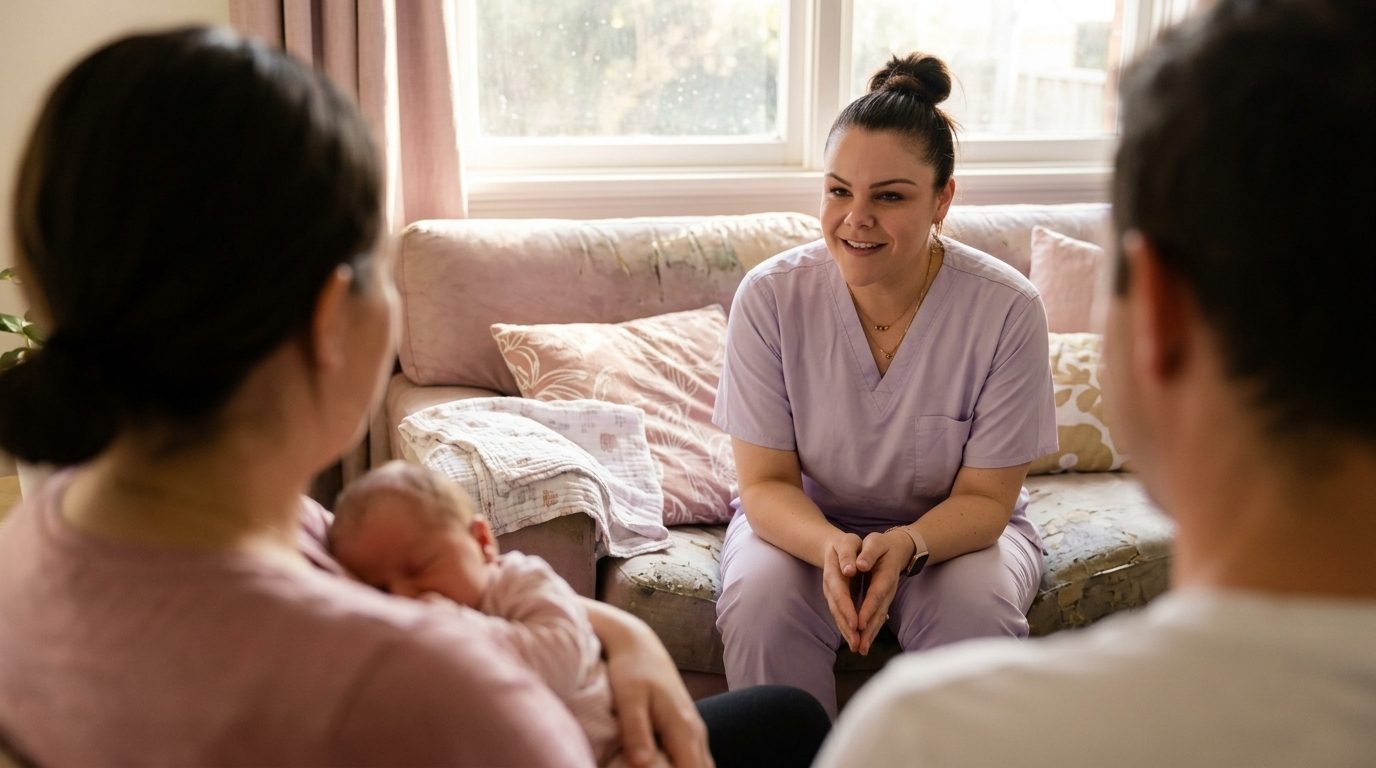
Adjusting to parenthood is the part nobody prepares you for, largely because it is hard to describe in advance. The pregnancy has a due date and the birth has a plan. What follows has neither, and it arrives while you are more tired than you have ever been. This is an honest look at what the early months tend to involve, what is ordinary, what is worth mentioning to someone, and where to find help in Australia if you need it.
Key Takeaways
- The baby blues are extremely common in the first week and usually pass without treatment.
- Symptoms lasting two weeks or more are worth raising with a midwife, GP or child health nurse.
- Up to 1 in 5 mothers and 1 in 10 fathers experience perinatal anxiety or depression in Australia.
- Partners adjust too, and are far less likely to be asked how they are going.
- Free national helplines exist and you do not need to be in crisis to ring one.
The first fortnight is its own thing
The term “baby blues” covers the mood swings, tearfulness and sense of being overwhelmed that turn up in the first week after birth. Pregnancy, Birth and Baby describes it as very common: about four in every five people who give birth go through it, usually around three to five days afterwards.
It generally passes on its own without any treatment. Knowing that in advance helps, because at the time it rarely feels like something that will pass.
Where the line sits
The distinction that matters is duration. If the feelings carry on for two weeks or more, that may be postnatal depression rather than the baby blues. Postnatal depression lasts longer, is more severe, gets in the way of looking after yourself or your baby, and does not usually lift on its own.
Two weeks is a useful marker to hold onto, because in the blur of early parenthood it is genuinely difficult to judge how long you have felt a particular way. If you are unsure, that uncertainty is itself a good enough reason to mention it to your doctor, midwife or child and family health nurse.
It is more common than most people realise
PANDA, the national perinatal mental health organisation, reports that up to one in five expecting or new mothers, and up to one in ten expecting or new fathers, experience perinatal anxiety or depression.
Those numbers are worth sitting with. When you are struggling, it is easy to assume you are the only one.
Partners are adjusting too
Partners get asked about the baby. They get asked how she is going. They are rarely asked how they are going, and the one in ten figure above suggests somebody probably should.
For partners, adjusting to parenthood looks different: often less about recovery and more about a sudden change in role, in sleep, in work and in the relationship. It is also easy for a partner to feel peripheral in the early weeks, particularly around feeding, which does nobody any good.
A midwife visiting at home sees both parents, not just the baby, and the early weeks are exactly what a postnatal visit is for.
What tends to help when adjusting to parenthood
None of this is profound, and all of it is easier said than done on no sleep:
- Lower the bar on everything that is not the baby or you. The house can wait several months.
- Accept specific help, and ask for specific help. “Let me know if you need anything” rarely converts. “Could you bring dinner Thursday” does.
- Protect one stretch of sleep. Broken sleep is unavoidable; never getting a single unbroken block is not.
- Talk to someone outside the house. A midwife, a child health nurse, a friend who has done it recently.
- Say the unflattering thing out loud. The thoughts people are most ashamed of are usually the most common ones.
Where to get help in Australia
You do not need to be in crisis to use any of these.
- PANDA runs a free national perinatal mental health helpline on 1300 726 306, for parents and for the people supporting them.
- Gidget Foundation Australia provides free perinatal mental health services for expectant and new parents.
- Pregnancy, Birth and Baby has a free helpline on 1800 882 436, seven days a week.
- Healthdirect has a registered nurse available on 1800 022 222 at any hour.
- Lifeline is on 13 11 14 if things feel urgent, and in an emergency call 000.
More of these are gathered on our resources page.
Frequently Asked Questions
How long do the baby blues last?
They usually appear around three to five days after the birth and pass on their own fairly quickly, without treatment. If you are not feeling better after two weeks, speak to your doctor or midwife.
Can a midwife help with how I am feeling, or only with the baby?
Both. A postnatal visit covers your recovery and wellbeing as well as your baby’s. A midwife can talk through how you are going and help you work out whether something needs following up with your GP or a mental health service.
My partner is struggling. Is there support for them?
Yes. PANDA’s helpline on 1300 726 306 is for fathers and partners as well as mothers, and for the people supporting them.
Is it normal not to feel an instant bond?
It is common, and it is one of the things parents are most reluctant to admit. For many people the feeling builds over weeks rather than arriving at once. If it is distressing you, or it is not shifting, it is worth raising with your midwife or GP.
Conclusion
Adjusting to parenthood is not a single moment you get through. It is a few months of learning a new job while under-slept, and most of what feels like failure in that period is simply the difficulty of the job.
The one thing worth holding onto is the two week marker. Feelings that persist past it, or that frighten you at any point, deserve a conversation rather than a wait-and-see. There are people whose whole role is to have that conversation with you, and they would much rather hear from you early.
Each EverNurture midwife takes her own bookings, and a home visit covers how you are going as well as how your baby is.