

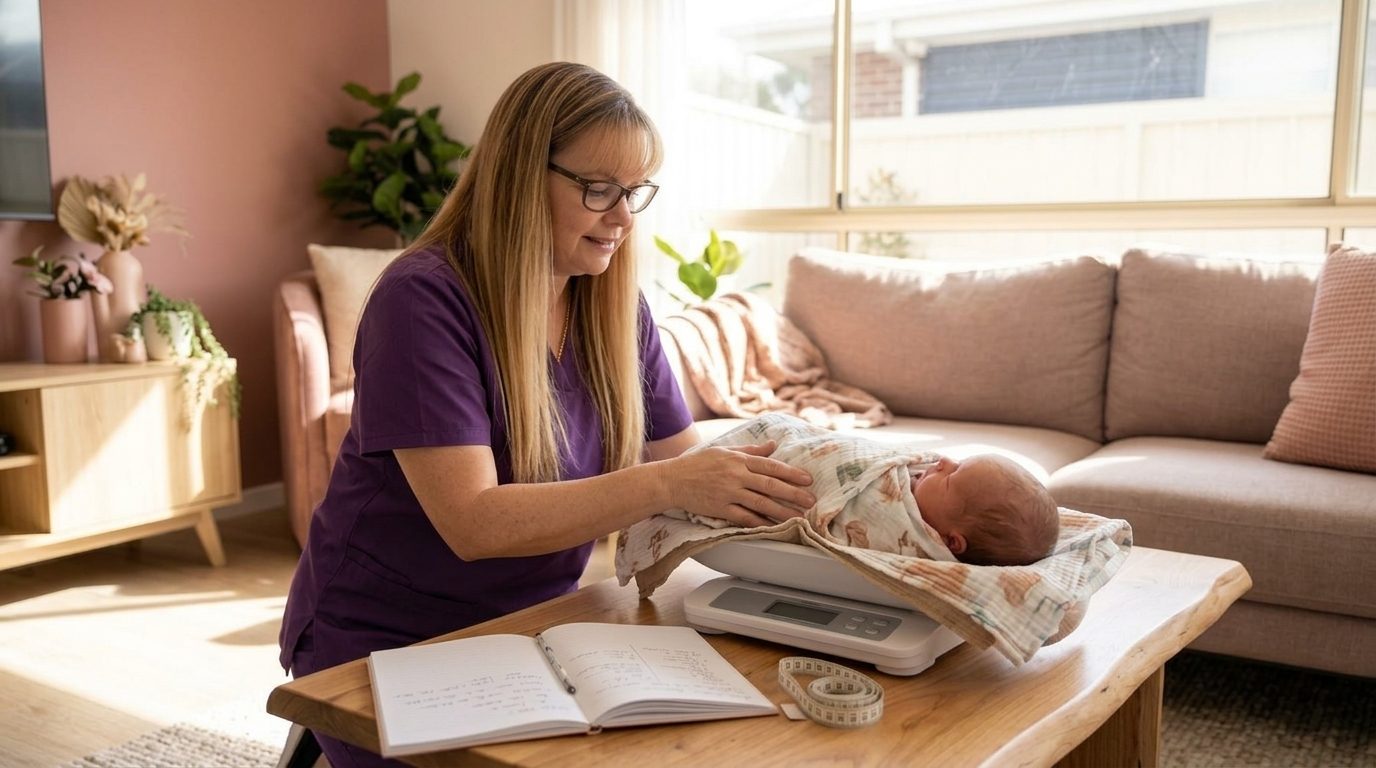
A midwife home visit is an unhurried appointment in your own home, usually around ninety minutes, covering how you are recovering, how your baby is feeding and growing, and whatever you have been wondering about since you got home. Nothing needs preparing: you sit where you normally sit and your baby stays with you. Letting someone into the house is still a different proposition from turning up to a clinic, so it is fair to want to know who will be in the room, what she will look at and how long she will stay. This is a walk through one, from the arrangement to the front door and out again.
Key Takeaways
- Expect conversation before examination. The first few minutes are her hearing how the days have gone.
- Nothing needs preparing. Somewhere comfortable to sit is the whole setup.
- She looks at you as well as your baby, and asks about your mood as a matter of course.
- If feeding is the reason you booked, time the visit near a feed so she can watch one.
- Keep a note on your phone in the days before. On the day, the list is the only thing that survives.
Arranging a midwife home visit
You deal with the midwife directly. She will ask a little about your birth, how feeding has been going and how you are healing, partly to know what to bring and partly because it shapes how long she allows. Then she agrees a time with you. If you have not picked a midwife yet, our guide to choosing a midwife sets out what to compare.
Be honest at that point about what is worrying you, even if it sounds small. It is better for her to arrive expecting the conversation than to discover it in the last five minutes.
Getting ready, or rather not
There is nothing to tidy and nothing to buy. A chair or sofa and a flat surface for your baby is genuinely all that is needed, and the state of the kitchen is not being assessed.
The one thing worth doing is writing your questions on your phone as they occur to you in the days before. Almost everyone forgets them the moment someone is actually sitting there.
When she arrives
Expect the first few minutes to be conversation rather than examination. She will want to hear how the days have been going, in your words, before she looks at anything.
Partners, other children and the dog are all part of the household, and none of them need to be elsewhere. Partners in particular tend to get the most out of the hands-on parts, so it is worth one being there if the timing allows.
The part about you
Your midwife will ask how you are healing after the birth, how you are sleeping and how you are coping, and she will ask directly rather than hint at it. Some of this may involve a physical check, depending on your birth and how you are going. She will explain anything before she does it, and you can decline any part of it.
Being asked plainly about your mood is not a sign anyone is worried. It is a standard part of the visit, and it is often the moment families find most useful.
The part about your baby
She will look at your baby, usually while you talk. What that includes depends on her routine and your baby’s age, and she will say what she is looking at as she goes. If you want to know why she is doing something, ask. The explanation is part of what you are paying for.
A clinic sees your baby for ten minutes in a room neither of you has been in before. A home visit sees the pram in the hallway, the chair you feed in and how you look at four in the afternoon.
Feeding, in your own chair
If feeding is on the list, she will usually want to watch an actual feed rather than discuss one. That is the real advantage of a midwife home visit: she sees the chair you use, the position you have fallen into, and the time of day when it goes worst. Advice that comes out of watching is far more specific than advice that comes out of describing.
Questions, and the ones people hold back
There is normally a stretch near the end where the conversation opens up. This is when the list on your phone pays off. Nothing on it will be too trivial, and the questions people apologise for asking are usually the ones a midwife hears every week.
How long it takes
Around ninety minutes is typical, though it varies with what is going on and each midwife sets her own. Ask when you book, so you can plan the rest of the day around it rather than watching the clock.
The postnatal home visits page sets out exactly what the care covers, so you can see whether it is what you actually need.
What happens afterwards
Before she leaves, you should be clear on three things: anything she has suggested you try, whether another visit makes sense, and how to contact her in the meantime. If something needs a GP, a lactation consultant or another service, she will say so and help you arrange it.
What it costs
All four EverNurture midwives hold an endorsement, which is what makes Medicare rebates possible on home visits for eligible families. The rebate applies within a limited window after your baby is born. Fees and the way a rebate is claimed are set by each practice, so settle both at the time you book. There is more on the rebates and fees page.
If something cannot wait until the visit
A midwife home visit is planned care. In an emergency, ring 000. For advice in the meantime, Healthdirect has a registered nurse on the line at any hour on 1800 022 222.
Frequently Asked Questions
How soon after the birth can a midwife visit?
That depends on the midwife and on what you need, and plenty of families arrange the first visit for the week or two after coming home. If you know in advance that you want support early, say so when you first make contact rather than waiting until you are home.
Can I have a home visit after a caesarean?
Yes, and it is one of the situations where care that comes to you earns its keep, because getting out of the house is harder. Tell your midwife when you book so she knows to allow time for how you are healing.
What gets written down, and who else sees it?
Checks on your baby go into your blue book, which stays with you and is where the next professional will look. Anything your midwife passes to your GP or another service is done with your agreement, and she will tell you what she is sending.
What if my baby cries the whole time she is here?
Then she sees what you are actually dealing with, which is more useful than a settled baby performing well for a visitor. An unsettled hour is information, not an embarrassment, and it is often the reason the visit was booked in the first place.
Conclusion
A home visit is not a test, an inspection or a clinical appointment squeezed into your lounge room. It is time with someone who knows what they are looking at, in the place where you are actually looking after your baby.
That setting is the point. It also saves you the thing you have least of in the early weeks, which is the energy to get out the door at all.
Every midwife takes her own bookings and can tell you her fee, the areas she visits and when she is free. You contact her directly, not a booking desk.